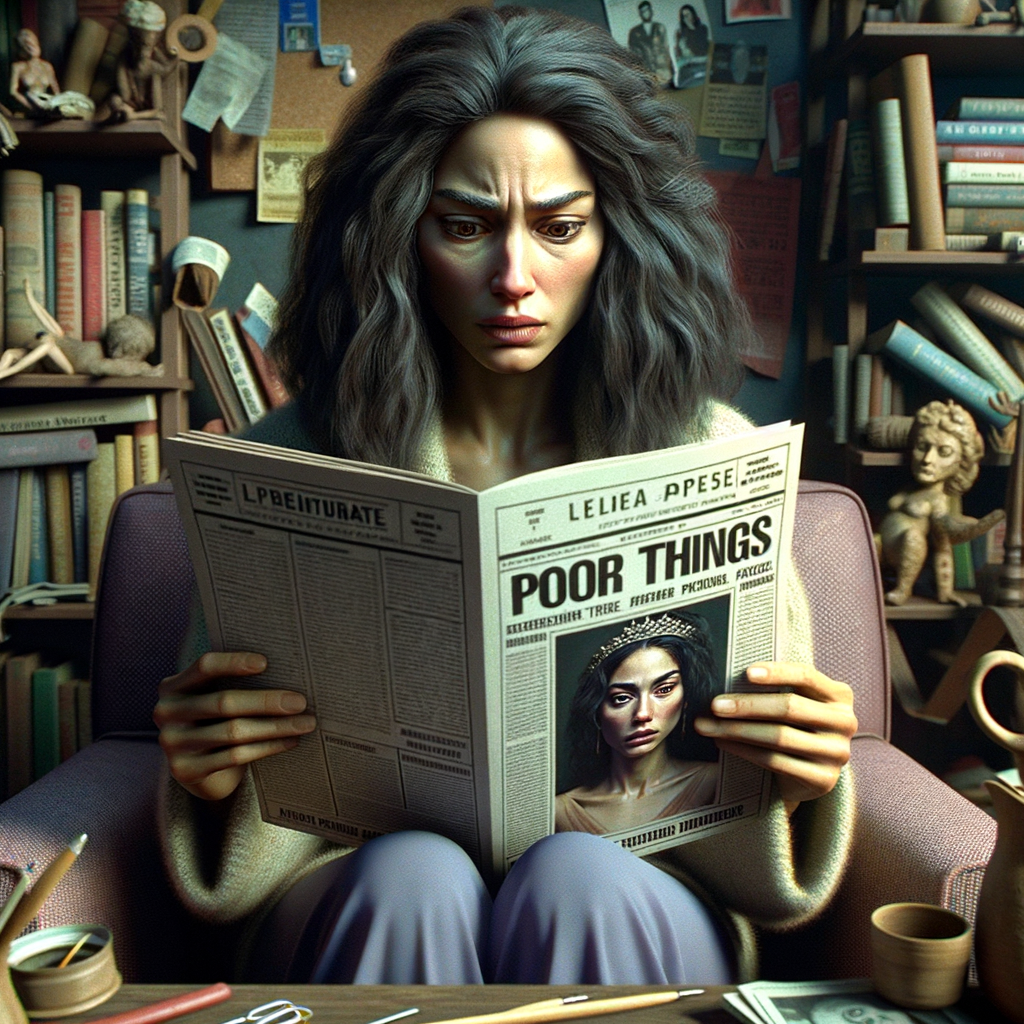
 Fiction created by GPT based on this news article.
Lysandra sat in her small apartment, flipping through the latest reviews of the controversial film, “Poor Things.” As a feminist and an activist, she prided herself on supporting media that empowered women and challenged the status quo. But the reviews she read made her uneasy, and she couldn’t shake the feeling that the film was a male fantasy disguised as feminist art.
The plot of the movie revolved around Bella, a woman with a child’s brain in an adult body, who embarks on a journey of self-discovery, including a strong desire for sex with multiple partners. As Lysandra read about Bella’s experiences working in a brothel and engaging in sexual encounters with numerous men, she couldn’t help but feel a growing unease.
She had always been an advocate for sexual liberation and the empowerment of women, but the depiction of Bella’s experiences felt off to her. The film seemed to be glorifying and romanticizing Bella’s sexual escapades, all the while dismissing the exploitation and degradation that often came with working in the sex industry. And to make matters worse, the reviews hinted at scenes that bordered on the line of pedophilia, only adding to Lysandra’s discomfort.
As she continued to read, she came across the viewpoints of various critics - some applauded the film for its bold portrayal of female sexuality, while others criticized it for perpetuating harmful stereotypes and male fantasies. And then there were those who believed that the film’s pseudo-feminism was nothing more than a façade to cover up its deeply troubling content.
Lysandra couldn’t shake the feeling that something wasn’t right. She believed that true feminist art should challenge the patriarchy, not cater to it. With a sense of determination, she made up her mind to watch the film for herself. She needed to form her own opinion and decide whether “Poor Things” was a celebration of female empowerment or a glorification of harmful male fantasies.
The following evening, Lysandra found herself seated in a small, independent cinema, waiting for the screening of “Poor Things” to begin. As the film played out before her, she watched as Bella’s character unfolded on the screen - a complex mix of childlike innocence and unapologetic sexuality. She saw Bella’s experiences in the brothel, witnessed her interactions with various men, and felt the discomfort grow within her.
But as the film progressed, Lysandra also recognized moments of self-discovery and defiance in Bella’s character. It was as if, despite the problematic portrayal, there was a glimmer of resistance and strength within Bella’s unapologetic pursuit of pleasure. The film prodded Lysandra to question her preconceived notions and confront the complexity of female sexuality. It was a turbulent mix of discomfort and defiance that left her deep in thought.
After the film ended, Lysandra rushed home, her mind swirling with conflicting emotions. She couldn’t deny the discomfort she felt while watching “Poor Things,” yet she also couldn’t shake off the moments of defiance and empowerment that Bella displayed. The film had challenged her to reevaluate her perspective on feminist art and female sexuality, forcing her to acknowledge the blurry lines that separated empowerment from exploitation.
As she sat in her apartment once more, Lysandra made a decision. She would use the contentious nature of “Poor Things” as a starting point for a discussion on the complexities of female empowerment and the portrayal of female sexuality in media. It was time to have a conversation, to open the floor to different viewpoints, and to challenge the norms of feminist art.
In the weeks that followed, Lysandra organized a series of panel discussions and open forums, bringing together artists, critics, and activists to dissect the themes and controversies of “Poor Things.” The conversations that ensued were passionate and thought-provoking, delving into the intricacies of female sexuality, exploitation, and empowerment. Lysandra found herself at the heart of a movement, shaping the discourse and challenging the norms of feminist art.
As she looked back on the journey that “Poor Things” had taken her on, she realized that the film had been a catalyst for change, stirring up conversations that had long been overdue. It was a masterpiece in its ability to challenge, to provoke, and to force its audience to confront uncomfortable truths. And in that discomfort, Lysandra found a new sense of determination - a determination to challenge the norms, shape the conversations, and redefine the boundaries of feminist art.