The Vanishing Assets: A Financial Scandal
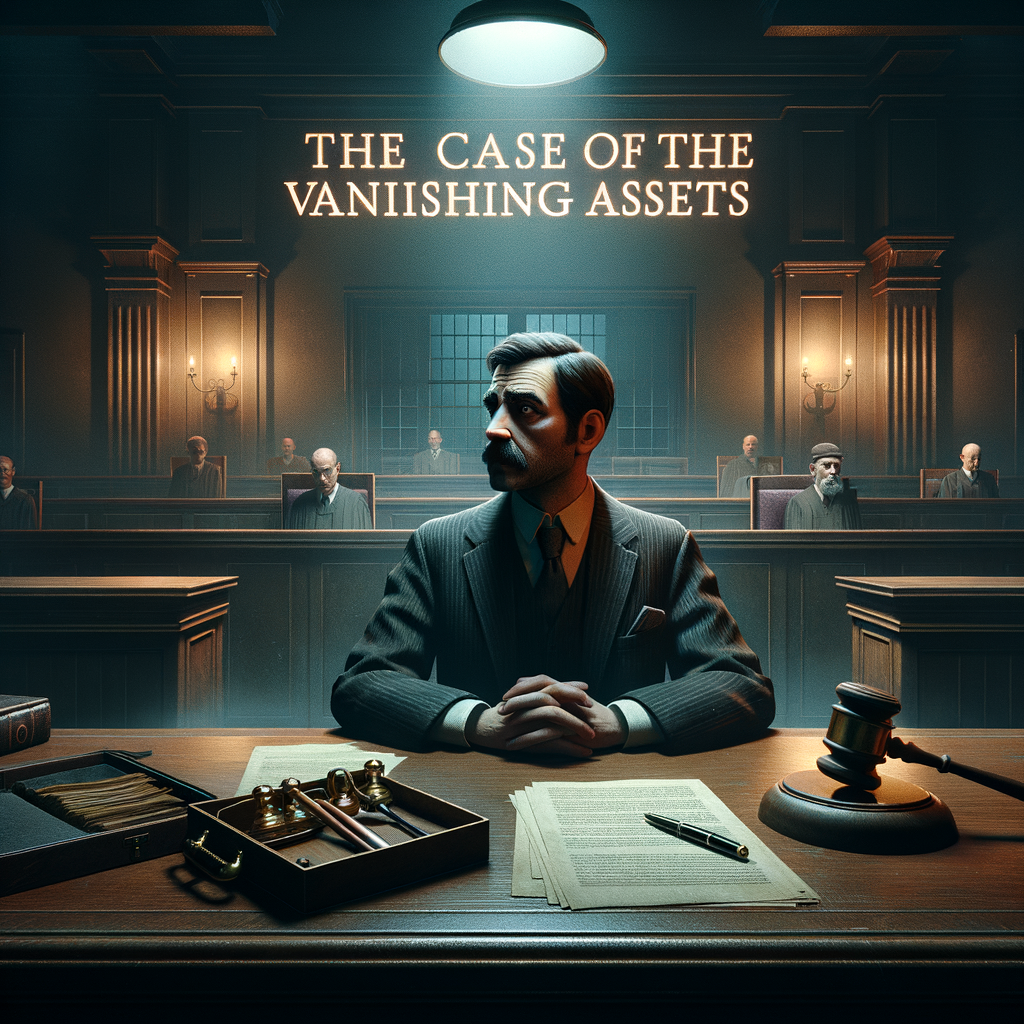 Fiction created by GPT based on this news article.
The Case of the Vanishing Assets
The atmosphere in the New York courtroom was tense as the judge, Olivia Montgomery, presided over the trial of the century. The defendant, Jonathan Thompson, sat stoically at the defense table, his eyes glancing nervously at the jury. The prosecution, led by district attorney Samantha Hayes, presented their case with a steely determination, aiming to prove that Thompson had committed a massive fraud by inflating the value of his assets on financial documents.
The trial had garnered national attention, with media outlets covering every twist and turn of the proceedings. Thompson, a wealthy businessman with a reputation for ruthlessness, had been the subject of intense scrutiny ever since the allegations of fraud had come to light. His company, Thompson Enterprises, had long been a powerhouse in the world of finance, but now it seemed that their empire was on the brink of collapse.
As the trial progressed, it became clear that the evidence against Thompson was overwhelming. The prosecution called on a series of expert witnesses who testified to the fraudulent nature of Thompson’s financial statements. It seemed as though there was no way for Thompson to escape conviction.
However, the defense was not without its own arsenal of legal firepower. Thompson’s team of high-powered attorneys, led by the formidable Caroline West, mounted a vigorous defense, attempting to cast doubt on the prosecution’s case. They argued that there was no clear evidence of fraudulent intent on Thompson’s part, and that the allegations were nothing more than a smear campaign orchestrated by his rivals.
As the trial neared its conclusion, the tension in the courtroom reached its peak. The judge, Olivia Montgomery, had the weight of the case on her shoulders as she prepared to deliver the verdict. The entire country held its breath, waiting to see if justice would be served.
Finally, the day of the verdict arrived. The courtroom was packed to capacity, with reporters jostling for prime positions to capture the moment. Judge Montgomery entered the courtroom with a solemn expression, her eyes fixed on Thompson as she delivered the decision.
“Jonathan Thompson, on the charges of fraud and inflating the value of your assets, I find you guilty,” she declared, her voice unwavering. “I hereby sentence you to pay a fine of $370 million and to be banned from conducting business in the state of New York.”
The courtroom erupted into a cacophony of noise as the verdict was announced. Thompson’s supporters hung their heads in disbelief, while the prosecution team exchanged triumphant glances. The media frenzy outside the courthouse was deafening as reporters clamored to be the first to break the news.
Thompson, for his part, remained composed as he listened to the judge’s words. His eyes were unreadable as he absorbed the magnitude of the sentence. As he was led away by court officers, there was a steely determination in his gaze, as though he was already plotting his next move.
In the weeks following the verdict, the fallout from the trial reverberated throughout the world of finance. Thompson Enterprises was thrown into chaos as investors fled and the company’s stock plummeted. The once-mighty empire seemed to be crumbling before the public’s eyes.
But the story was far from over. In a surprising turn of events, new evidence came to light that cast doubt on the validity of the verdict. It was revealed that key financial documents had mysteriously vanished from the court records, raising questions about the integrity of the trial.
Rumors swirled about a shadowy figure who had tampered with the evidence in an attempt to frame Thompson. Some speculated that it was a rival business tycoon, seeking to eliminate a powerful competitor. Others whispered about a high-level conspiracy, involving powerful figures with a vested interest in seeing Thompson brought down.
As the controversy deepened, the case was reopened, and a new investigation was launched to uncover the truth. The new developments sent shockwaves through the legal and financial worlds, as everyone waited to see what would be uncovered.
In the midst of the chaos, Thompson remained a figure of mystery. He retreated from the public eye, his whereabouts unknown. Some whispered that he was plotting his revenge, biding his time until he could clear his name and reclaim his lost fortune. Others speculated that he had fled the country, seeking refuge in a distant land where he could evade the law’s grasp.
As the investigation continued, the truth slowly began to emerge. It was revealed that the missing documents had been part of a carefully orchestrated scheme to frame Thompson and destroy his business. The real mastermind behind the plot was unmasked, and the shocking extent of the conspiracy sent shockwaves through the highest echelons of power.
In the end, Thompson was exonerated, and his name was cleared of all charges. The true perpetrators of the fraud were brought to justice, and the world of finance was left reeling from the scandal.
But Thompson himself remained an enigma, his true motives and intentions shrouded in mystery. Some whispered that he had orchestrated the entire affair as a way to eliminate his rivals and cement his hold on the business world. Others believed that he had been an innocent victim, caught up in a web of deceit and betrayal.
Whatever the truth may have been, one thing was certain: the case of the vanishing assets had left an indelible mark on the world of finance, and the shadow of Jonathan Thompson loomed large over the industry for years to come.