The Crisis in Eastern Europe
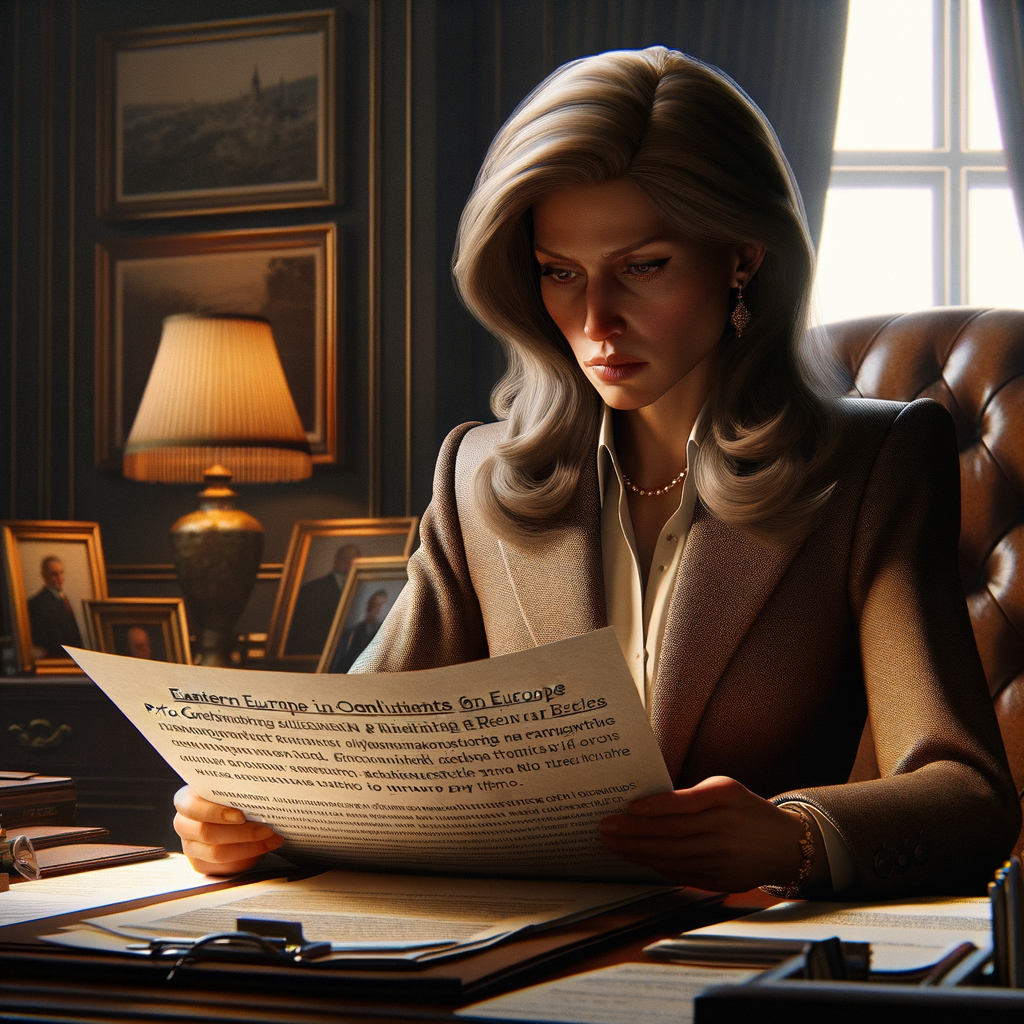 Fiction created by GPT based on this news article.
The American president, Samantha Reynolds, sat in the Oval Office, reading through the latest reports from Europe. The tension between Russia and Ukraine was reaching a boiling point, and she knew that the situation could escalate at any moment. She had already spoken to her advisors about the possibility of providing military aid to Ukraine, but the political climate in Washington was making it difficult to secure the necessary funds.
As she pondered her next move, her phone rang. It was her secretary, informing her that the British Prime Minister, Alexander Thornton, was on the line. She quickly picked up the phone and greeted him warmly.
“Good morning, Prime Minister Thornton. To what do I owe the pleasure of this call?” she asked.
“Good morning, President Reynolds. I just wanted to inform you that the UK has made a commitment to Ukraine’s defense. We have pledged £2.5bn to support their efforts in case of a Russian attack,” Thornton replied.
Reynolds felt a sense of relief wash over her. The UK’s support would certainly help to alleviate some of the strain on the US budget. She thanked Thornton for the update and promised to discuss the matter further during their upcoming meeting at the NATO summit.
After she ended the call, Reynolds took a moment to think about the situation. It was clear that tensions were rising, and she needed to act quickly to ensure that the US was prepared to support Ukraine if the need arose.
Meanwhile, in Ukraine, President Volodymyr Ivanov was feeling cautiously optimistic. The UK’s commitment to their defense was a much-needed boost, but he knew that they still needed more support from their allies. He had arranged a meeting with the Polish Prime Minister, Katarzyna Nowak, to discuss the possibility of further collaboration between their countries.
As Ivanov and Nowak sat down to talk, they were interrupted by a message from their military spy chief, Yuri Petrov. Petrov informed them that there were reports of increased Russian military activity near the border. It seemed that the threat of an attack was growing by the day.
Ivanov and Nowak knew that they needed to act fast. They quickly drew up plans for a joint defense strategy and reached out to their allies for support. They were relieved to hear that the US was considering providing military aid, and they hoped that other NATO members would follow suit.
Back in Washington, President Reynolds was facing fierce opposition from Congress. Many politicians were hesitant to allocate funds for military aid to Ukraine, citing concerns about getting involved in another conflict. Reynolds knew that she needed to find a way to change their minds.
She decided to address the nation in a televised speech, outlining the importance of supporting Ukraine and standing up to Russian aggression. She spoke passionately about the need for unity among NATO members and emphasized the threat that Russia’s actions posed to global stability.
The speech had a powerful impact, and public opinion began to shift in favor of providing aid to Ukraine. This shift in sentiment put pressure on Congress to act, and they ultimately approved the necessary funds to support Ukraine’s defense efforts.
With the backing of the US and the UK, Ukraine felt emboldened to take a stronger stance against Russian aggression. They intensified their attacks in Russian-annexed Crimea, catching Moscow off guard. The Russian economy, which had been surprisingly resilient, began to falter under the strain of increased sanctions and the escalating conflict.
As the situation continued to unfold, President Reynolds and Prime Minister Thornton maintained close contact with President Ivanov and Prime Minister Nowak. They worked together to coordinate their efforts and ensure that they were prepared for any developments on the ground.
The tension between Ukraine and Russia reached a breaking point when a Russian shelling killed two people in the southern Ukrainian city of Odessa. In response, Ukrainian forces launched a drone attack in the Moscow-controlled east, resulting in casualties on both sides.
The international community was on edge, fearing that the conflict could escalate into a full-blown war. President Reynolds and Prime Minister Thornton realized that they needed to take decisive action to prevent a catastrophic outcome.
They called for an emergency meeting of NATO members and worked tirelessly to build a coalition of support for Ukraine. Their efforts paid off, and they were able to secure a commitment from NATO to deploy a peacekeeping force to the region.
The presence of the NATO peacekeepers helped to de-escalate the situation, and a ceasefire was eventually brokered between Ukraine and Russia. The conflict had taken a heavy toll on both sides, but the international community’s swift action had prevented a larger-scale catastrophe.
In the aftermath of the conflict, President Reynolds and Prime Minister Thornton were hailed as heroes for their leadership and commitment to preserving peace. They had succeeded in rallying support for Ukraine in its time of need, and their efforts had a lasting impact on the region.
As for Ukraine, the country began the long process of rebuilding and recovery. With the support of their allies, they were able to strengthen their defenses and secure their borders, ensuring that they would be better prepared to defend themselves against future threats.
The conflict had been a harrowing experience, but it had also brought about a newfound sense of unity and determination among the international community. The world had come together to stand up against aggression and protect the principles of freedom and sovereignty.
And as President Reynolds reflected on the events that had transpired, she knew that she had made the right decision to support Ukraine. The country had faced tremendous adversity, but with the help of their allies, they had emerged stronger and more resilient than ever.